Specialised surgery for peritoneal carcinomatosis
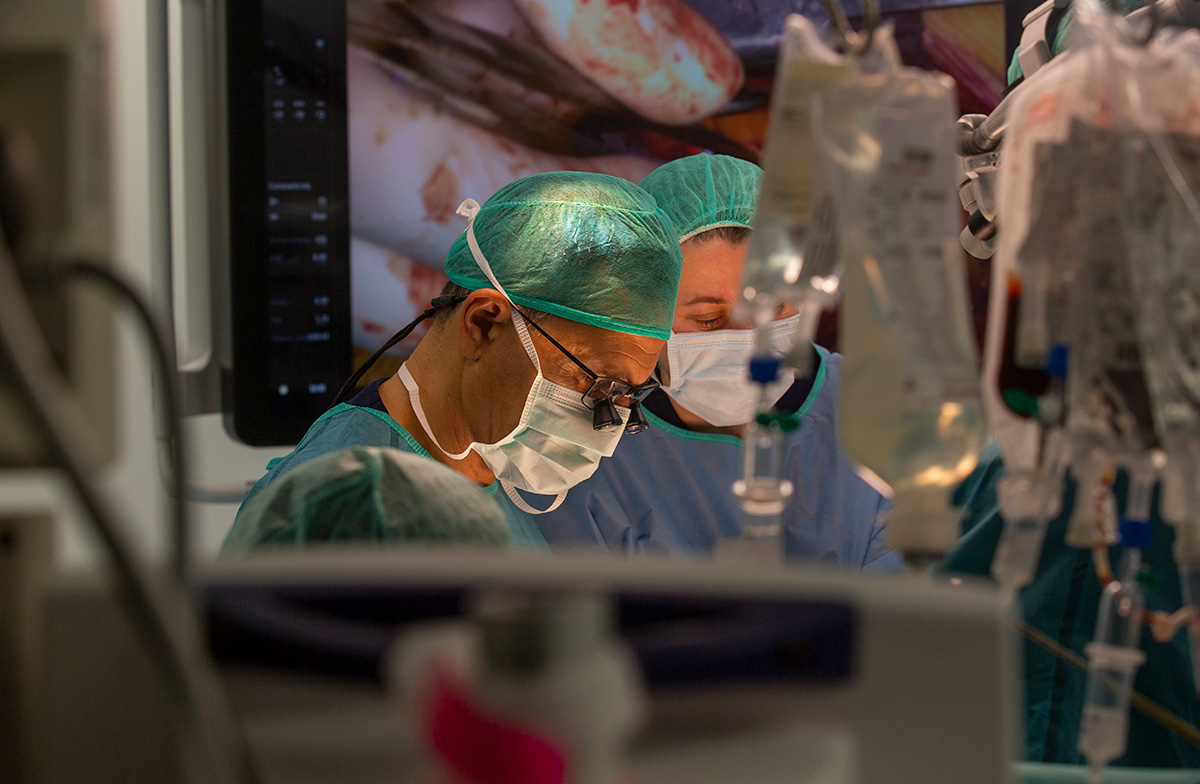
We are one of Europe’s highest-volume centres for cytoreductive surgery (CRS) with HIPEC, having performed more than 2,000 procedures.
Ask our specialists to review your case and assess whether any of these treatments may be suitable for you before you make any decision about travelling to Spain.
No cost. No obligation.
Conditions that may be treated with CRS + HIPEC or PIPAC
Could CRS + HIPEC or PIPAC be suitable for you?
Only a limited number of centres worldwide have the experience required to diagnose and treat different types of peritoneal malignancies and metastases with this level of precision and personalisation. If you have been diagnosed with any of the following conditions, we can provide a highly specialised assessment:
Peritoneal mesothelioma
For selected patients, cytoreductive surgery with HIPEC is an established specialist treatment approach.
Pseudomyxoma peritonei
A rare condition, usually caused by a mucinous tumour originating in the appendix, for which cytoreductive surgery with HIPEC is an established specialist treatment in selected patients.
Ovarian cancer with peritoneal spread
Including recurrent disease and cases in which systemic chemotherapy has not achieved adequate disease control.
Colorectal cancer with peritoneal metastases
Some patients may benefit from cytoreductive surgery with HIPEC.
Gastric cancer with peritoneal involvement
PIPAC may be considered in selected cases, and research into its role is ongoing.
Primary peritoneal serous carcinoma
A rare cancer that begins in the peritoneum and is closely related to high-grade serous ovarian and fallopian tube cancers.
Other diagnoses associated with peritoneal spread
Including neuroendocrine tumours, small bowel tumours, pancreatic and biliary tract tumours, urachal tumours, GISTs and sarcomas.
Not sure whether a specialist assessment could help?
Send us your medical history. We will review it at no cost and provide a clear, specialist opinion on whether any of these treatment options may be suitable for you.
Why choose PCI in Spain for your treatment?
The UK has highly regarded NHS and private cancer services. However, in surgery for peritoneal carcinomatosis, outcomes are strongly influenced by a centre’s procedure volume and the specific experience of its multidisciplinary team. For patients in the UK seeking a specialist second opinion, Peritoneal Cancer Institute offers a remote case assessment before any decision is made about travelling to Barcelona.
1. Surgical volume
We perform more than 150 CRS + HIPEC procedures each year, and our team is a leading training centre for this technique, endorsed by the European Society of Surgical Oncology (ESSO) and the Peritoneal Surface Oncology Group International (PSOGI).
Because of PCI’s high level of specialisation and the number of patients treated each year, surgeons from around the world travel to Barcelona to train in this technique before introducing it at their own hospitals or to further develop their expertise.
2. PIPAC as part of routine clinical practice at PCI
PIPAC (Pressurised Intraperitoneal Aerosol Chemotherapy) is a minimally invasive laparoscopic procedure that delivers chemotherapy directly into the abdominal cavity as a pressurised aerosol. This may improve the distribution of the chemotherapy and its penetration into tumour tissue. In the UK, NICE recommends that PIPAC should only be used in the context of research because the available evidence on its efficacy is currently inadequate in quality. At PCI, we have offered PIPAC in routine clinical practice for more than six years as an option for selected patients who are not initially suitable for radical surgery. The aim may be to control disease progression or, in some cases, reduce the tumour burden before reassessing whether cytoreductive surgery (CRS) with HIPEC may be possible.
3. You speak directly to the surgeon who will operate on you
From your first consultation through to hospital discharge, you will receive personalised care. Your clinical case manager will direct your questions to the appropriate member of the specialist medical team, ensuring clear and clinically informed communication. Questions about complex cancer surgery deserve answers from the specialists responsible for your care.
4. Transparent cost
We provide a complete written quotation before you make any decision. There are no unexpected fees, separate invoices from other specialists or hidden charges. The treatment cost is set out in advance, allowing self-funding patients from the UK to understand and compare the cost of private treatment in Barcelona before they commit.
A multidisciplinary team dedicated exclusively to CRS + HIPEC and PIPAC
The team that will review your case
Surgical oncologists, medical oncologists, anaesthetists, intensive care specialists, radiologists, consultant physicians, pathologists, nutrition specialists, rehabilitation specialists and specialist nursing staff.
Every member of the team focuses on peritoneal disease. Each case is discussed by the multidisciplinary team before a personalised treatment plan is proposed.
Dr. Domenico Sabia
Dr. Lana Bijelic
Chief, Peritoneal Surface Malignancies Unit, Consorci Sanitary Integral
How the case assessment works
From your initial enquiry to your treatment plan: a clear process with no small print.
Step 1: You complete the initial form (5 minutes)
Complete the online form with your diagnosis, treatment history and contact details.
Step 2: Our clinical case manager contacts you
Your first point of contact will be a clinical case manager dedicated exclusively to international patients at Peritoneal Cancer Institute.
Your clinical case manager will support you throughout the assessment process, understand the details of your case, help with administrative questions and liaise with the surgical team on clinical matters when needed.
Step 3: You upload your medical history to a secure platform
You will receive a link to a secure, encrypted portal where you can upload the medical information available about your case. The team will need:
- Your complete medical history
- Original scan images, such as CT, PET-CT or MRI
- Most recent radiology reports
- A scanned copy of your passport or identity document so that you can be registered on the hospital system
If you experience any technical problems during this process, our technical support team will help you.
If you are unsure how to obtain any of this information, your clinical case manager will explain what is needed and how to request it from your NHS service or private healthcare provider.
Step 4: Documentation review and multidisciplinary assessment
Your case is reviewed through the following process:
- First, the clinical case manager reviews the documentation for completeness, identifies any critical information that is missing and prepares a structured summary for the medical team.
- Your case will then be presented to the multidisciplinary team: surgical oncologists, medical oncologists, pathologists and radiologists specialising in peritoneal carcinomatosis will jointly review and discuss your case.
- If the expert team concludes that Peritoneal Cancer Institute cannot offer a suitable treatment for your case, we will explain this clearly by email and the initial assessment will remain free of charge. If you subsequently request a formal medical consultation or written medical report, the standard consultation fee will apply.
Our commitment is to be honest and prioritise your well-being. We will not recommend treatment unless the expected benefits justify it.
Step 5: Medical consultation and fixed-price quotation
If the expert team determines that a particular treatment may be suitable for you, we will arrange a medical consultation, usually by video call. During the consultation, the PCI surgeons will explain your diagnosis and the proposed multidisciplinary treatment strategy.
- The treatment options recommended for your case
- The clinical reasoning behind the recommendations and treatment objectives
- The risks specific to your situation
- The complete plan: treatment sequence, duration and follow-up
A few days after the consultation, you will receive a complete medical report containing PCI’s recommendations and a fixed-price quotation for the proposed treatment package.
Step 6: You decide how to proceed, with all the information you need
After receiving the recommendations and quotation, you decide how to proceed. We will answer any further questions and help you make an informed decision without unnecessary delay.
Your clinical case manager will remain your main point of contact if you have any additional questions.
If you would like your UK oncologist, NHS multidisciplinary team or private consultant to review the plan, we will provide PCI’s treatment recommendations and the supporting documentation in English.
Step 7: Treatment in Barcelona and follow-up from home
If you decide to proceed with the recommended treatment plan, the Peritoneal Cancer Institute team will coordinate your preoperative preparation, hospital admission and arrival arrangements so that the process is as straightforward as possible.
After discharge, you will receive a report detailing the treatment provided and your clinical progress at Teknon Medical Centre. Our team will remain available to advise you if any complications arise. Following your initial recovery, we will continue to monitor your progress through a follow-up appointment.
Frequently asked questions
These are some of the questions most frequently asked by patients from the UK who are considering specialist assessment or treatment in Spain. If your question is not answered here, please contact us directly and we will be happy to help.
About the initial assessment
Does it cost anything to send my reports from the UK to find out whether I may be suitable for treatment?
No. There is no charge for submitting your clinical documentation and scan images through our secure portal. The clinical case manager checks that the documentation is complete before your case is reviewed by our multidisciplinary medical team. If the team determines that none of our treatments is suitable for you, we will inform you by email at no cost.
How do I know whether HIPEC or PIPAC may be suitable for me?
Eligibility depends on several factors: the type of primary cancer, the extent of the peritoneal disease, scan findings, previous surgery, response to chemotherapy, nutritional status and overall health. A specialist team needs to review your complete medical history before advising whether either treatment may be suitable.
This is why the initial assessment is free of charge.
What is the difference between HIPEC and PIPAC?
HIPEC (Hyperthermic Intraperitoneal Chemotherapy) is given during cytoreductive surgery. After the surgeon has removed as much visible disease as possible, a heated chemotherapy solution, usually at around 42°C, is circulated within the abdominal cavity to treat microscopic cancer cells that may remain.
PIPAC (Pressurised Intraperitoneal Aerosol Chemotherapy) is a minimally invasive laparoscopic procedure in which chemotherapy is delivered into the abdominal cavity as a pressurised aerosol. It may be repeated in treatment cycles, sometimes alongside systemic chemotherapy, depending on the individual treatment plan.
The most appropriate treatment depends on your diagnosis and individual clinical factors. The specialist oncology team will advise you after reviewing your complete medical history.
If HIPEC is not possible in my case, can I consider PIPAC?
For selected patients, yes. PIPAC may be considered when CRS + HIPEC is not currently appropriate—for example, when the tumour burden is too extensive for complete surgery or when the aim is to control the disease before reassessing whether surgery may be possible. However, PIPAC is not suitable for every patient or tumour type. A specialist team must assess your individual case.
Do I have to travel to Spain just to find out whether treatment may be suitable for me?
No. The entire initial assessment process can be completed remotely. You upload your documentation to the PCI portal, the team reviews it and, where appropriate, arranges a video consultation with the PCI SURGEONS. You only need to travel to Barcelona if treatment is recommended and you decide to proceed.
Who will be my first point of contact?
A clinical case manager dedicated exclusively to international patients at Peritoneal Cancer Institute will be your first point of contact. They will support you throughout the assessment process and communicate with you by email or telephone. If you decide to travel to Barcelona, the Teknon Medical Centre International Department will coordinate the details of your arrival.
Can a family member submit the case on my behalf?
Yes. Many requests are submitted by spouses, children or close relatives, particularly when the patient is in the middle of a chemotherapy cycle or does not feel they have the energy to manage the process. We only ask that the patient has authorised the exchange of medical information before any reports or personal health information are submitted.
About cost and insurance
Is the quotation genuinely fixed, or will I be charged extra if complications arise?
We operate under a strict fixed-price policy.
Our fixed-price quotations cover every stage included in the recommended treatment plan. Depending on the treatment proposed, this may include the preoperative assessment, surgery, HIPEC or PIPAC, anaesthesia, admission to the intensive care unit, the hospital stay, multidisciplinary care during recovery and the management of any medical or surgical complication requiring an extended stay or additional procedures.
For the treatment covered by the quotation, you will not pay more than the amount agreed at the outset. There are no separate invoices from other specialists, room charges or additional charges if an unexpected postoperative complication requires further treatment. The precise scope and inclusions will be set out in your written quotation. No small print.
The quotation also includes a bed and meals for one companion throughout your hospital stay.
Will my insurance cover it?
This depends on the terms of your private medical insurance policy. Some policies may cover planned treatment overseas, but prior authorisation is usually required. The S2 planned treatment route applies only to state-provided care and does not cover private treatment. A GHIC or EHIC also does not cover planned private treatment.
We will provide the clinical and administrative documentation your insurer may require, and the Teknon International Department can support you during the process. However, cover is determined by your insurer and the specific terms of your policy.
What happens if none of the treatments is suitable for me?
If, after reviewing your medical history, the PCI multidisciplinary team determines that none of the treatments offered is suitable for you, we will inform you in writing at no cost. This is the purpose of the initial assessment: to help you avoid unnecessary travel and expense.
About treatment and risks
What are your complication and mortality rates for this surgery?
Cytoreductive surgery with HIPEC is a major procedure with significant risks. These vary according to the complexity of the surgery, your individual health and the experience of the surgical team. It is important that you understand these risks before making a decision.
At our centre, 30-day mortality is 0.2%, the overall complication rate is approximately 30%, and the major complication rate is 5%. Your individual level of risk will be explained during the consultation, taking into account your diagnosis, general health and the complexity of the proposed procedure.
How long would I need to stay in Barcelona?
This depends on the treatment and your clinical progress.
For CRS + HIPEC, the usual hospital stay is 14–21 days, including admission on the day before surgery for preoperative preparation.
Some patients return home after hospital discharge, while others prefer to remain in Barcelona for a further 4–5 days to rest. Fitness to fly or travel is assessed individually before discharge and will depend on your recovery.
For PIPAC, the stay is significantly shorter—usually two days—as it is a minimally invasive procedure.
In all cases, the expected schedule will be discussed during the medical consultation, as it depends on the complexity of the proposed treatment and your recovery.
Will I receive a written treatment plan before travelling?
If the PCI multidisciplinary team determines that treatment options are available in your case, you will receive a complete medical report with clear recommendations before making your final decision. This includes the expected treatment sequence, proposed surgical technique, estimated hospital stay, recovery considerations, follow-up plan and complete fixed-price quotation.
About logistics and family
Will I be able to communicate with the medical team in English?
Yes. All members of the medical team caring for you speak fluent English, and all the clinical documentation you receive will be in English. If you prefer, members of the PCI medical team can also communicate in Italian, French or Croatian.
Interpreter services for Russian and other languages are available through the Teknon Medical Centre International Department at no additional cost.
Who will help me with travel and accommodation arrangements?
The Teknon International Department assigns you a dedicated coordinator to arrange:
- Any supporting medical or admission documents you may need for travel
- A list of hotels near the hospital with negotiated rates for additional companions
- Airport transfers
- Interpreter support should you require it at any time
- Complete coordination of your hospital admission from the moment you land
You arrange your flights and are responsible for checking the current UK and Spanish entry requirements. We provide the medical and admission documents needed to make the process as straightforward as possible.
Can my family stay with me during my hospital admission?
Yes, absolutely. Teknon’s rooms are 46–50 m² suites specifically designed to allow one companion to remain with you 24 hours a day, with sleeping space, a full bathroom and a sitting area.
For family members who are not staying in the room, we provide a list of hotels near the hospital with negotiated rates.
Will you help with travel documentation?
Yes. Our team provides the relevant medical and admission documentation to support your journey. British citizens can normally visit the Schengen area for up to 90 days in any 180-day period without a visa, but you should always check the latest entry requirements before travelling. If additional documentation is required, we will provide the relevant medical documents.
About continuity of care and the team
Can my UK oncologist or NHS team be involved in the process?
Yes, and we actively encourage this. Before surgery, we can share the treatment plan with your NHS multidisciplinary team, oncologist or private consultant if you wish. After treatment, we provide the surgical documentation and subsequent histopathology results in English so that your UK team has the information needed to continue your follow-up care.
What happens if I experience a complication after returning home?
Although the risk of a significant complication generally falls as recovery progresses, complications can still occur after you return home. You will therefore have direct access to the surgical team by email and video consultation. If a complication requires in-person care, we will liaise directly with your UK oncology team or local hospital and provide the clinical information they need.
Do you have a question that is not answered here?
We are here to help you.
Contact us or submit your case directly. Anabel will respond personally.