A Pioneering Procedure for the Treatment of Peritoneal Metastases
PIPAC: Pressurized Intraperitoneal Aerosol Chemotherapy
Receiving a diagnosis of peritoneal carcinomatosis can be overwhelming. However, being told that traditional surgery is not an option at this time does not mean there are no other alternatives.
At Peritoneal Cancer Institute we perform the PIPAC technique , which has marked a turning point in the management of peritoneal disease, offering a minimally invasive approach to directly treat lesions in the abdomen and significantly improve your quality of life.
What is PIPAC chemotherapy?
Superior oncological precision: maximum efficacy
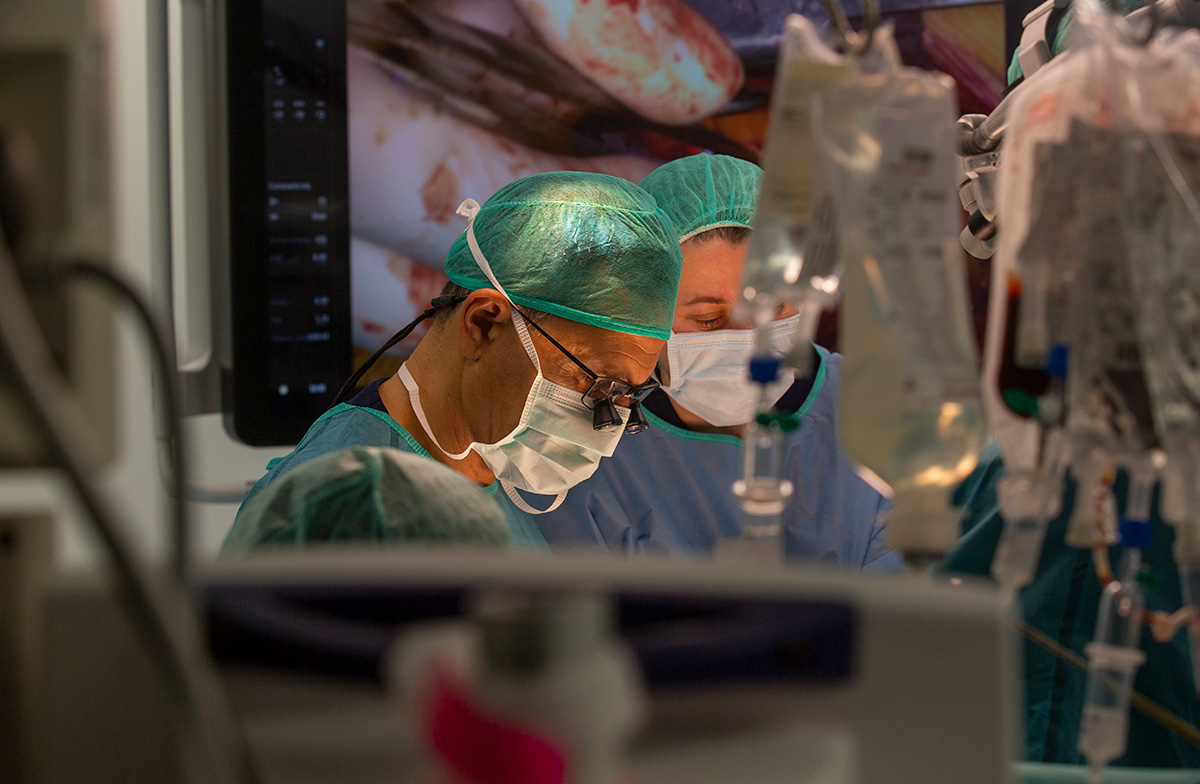
The PIPAC is an innovative surgical procedure that allows oncologic surgeons to administer chemotherapy drugs directly into the abdominal cavity.
Unlike traditional intravenous systemic treatments, intraperitoneal aerosolized chemotherapy (PIPAC) is administered as a pressurized aerosol. This nebulization allows the drugs, in the form of microparticles, to penetrate more deeply into the peritoneal tissues in a much more uniform and direct manner, attacking tumor cells through direct contact. Because it is such a localized procedure, a lower dose of medication is used, which drastically reduces side effects.
Exclusive Specialization in PIPAC Chemotherapy
Why choose Peritoneal Cancer Institute
Treating diseases of the peritoneum requires a level of precision and expertise that goes beyond general oncology. At a conventional hospital, your case may be just one among hundreds of different conditions. At the Peritoneal Cancer Institute (PCI), diseases of the peritoneal surface are our sole focus.
- Hyperspecialization: Our team is dedicated exclusively to treating peritoneal diseases and their underlying causes. We understand every nuance of chemotherapy PIPAC.
- Committee Decisions: Your case is not evaluated by a single doctor, but by a multidisciplinary team of experts dedicated exclusively to your condition.
- True Support: We understand your illness and your fears better than anyone else. You are our top priority.
PIPAC Technician at the Peritoneal Cancer Institute
A high performance center dedicated to you
Peritoneal Cancer Institute performs its procedures at the facilities of the Teknon, a hospital setting of international excellence. Here, our philosophy centers on personalized medicine: we don’t treat diseases—we treat people—with a team dedicated to your physical and emotional recovery.
Who is PIPAC aerosol chemotherapy recommended for?
Every diagnosis is unique. Take the first step toward a personalized evaluation of your case.
The PIPAC technique opens a window of opportunity for patients with peritoneal carcinomatosis who, at this time, are not viable candidates for cytoreductive surgery (CRS) combined with HIPEC.
Advanced peritoneal disease
You have advanced peritoneal disease originating in the stomach, colon, ovaries, or the peritoneum itself.
Reduce the tumor burden
We are looking to reduce the tumor burden so that, in the future, you may be a candidate for cytoreductive surgery.
Relieve symptoms
The main goal is to to alleviate symptoms, control ascites—that is, the accumulation of fluid in the abdomen—and restore your quality of life.
How the PIPAC Intervention Works
Cutting-edge technology through millimeter-sized incisions
Your safety and comfort are our top priority. The procedure PIPACprocedure, being a laparoscopic procedure, is minimally invasive. Here’s how we take care of you in the operating room:
Anesthesia and Preparation
It is performed under general anesthesia. You won’t feel a thing.
Laparoscopic access
We make tiny, almost imperceptible incisions in your abdomen to insert a small camera and the instruments.
Visual examination and biopsies
We assess the actual condition of the abdominal cavity and take precise samples to analyze the tumor’s response.
Nebulization
Using a special device, we administer the chemotherapy in the form of a high-pressure aerosol. This is left in your abdomen for about 30 minutes to ensure maximum absorption.
Extraction and Closure
We safely suction out the remaining aerosol and close the incisions.
Leading medical team in the PIPAC technique
Pioneering specialists by your side
Behind the most advanced technology are people. Our team of surgical oncologists has elite training at leading international centers specializing in peritoneal treatments.
They have the technical expertise to maximize the effectiveness of PIPAC intraperitoneal chemotherapy, but they stand out for something even more important: their ability to listen to you. They’ll explain every step, communicate with you with complete transparency, and support you from your first appointment through the end of your recovery.
Dr. Domenico Sabia
Dr. Lana Bijelic
Chief, Peritoneal Surface Malignancies Unit, Consorci Sanitary Integral
Results of PIPAC aerosolized chemotherapy
Tangible Results: Beyond Symptom Relief
The biggest advantage of the PIPAC is that it can be repeated several times to maximize its effect against the tumor. Since only small incisions are made and reduced doses of medication are used, overall toxicity is very low.
In the vast majority of cases, patients experience a substantial improvement in their quality of life. We achieve excellent pain control and a significant reduction in abdominal fluid. In many cases, we see tumors shrink in size, opening the door to new treatments.
Stories from patients who have received PIPAC treatment
Actual Results
“I believe the PIPAC treatment gave her a few extra months of life that she otherwise would not have had. I am grateful. Thank you for helping us when no one else could. Our experience was positive, and the tumor markers decreased after the procedure.”
“I’m happy with the treatment I received. So far, the results of the surgery are excellent. Tumor markers negative. CT scan reports within normal limits.”
“The professionalism of Dr. Sabia and his team is beyond doubt; the operation was carried out correctly, but unfortunately the tumor came back. We understand that neither Dr. Sabia nor his team are to blame for this.”
“Very good professionals.”
“Dr. Sabia is a kind, approachable, and humane person. The results are good; I have regular check-ups every six months.”
Frequently Asked Questions About the PIPAC Procedure
Is the PIPAC treatment a permanent cure for my illness?
We understand that this is the question that matters most to you. Currently, this technique is considered a palliative or supportive therapy—not curative on its own. Its main goal is to slow the tumor’s progression and improve your quality of life. However, in some cases, an excellent response to aerosol chemotherapy can shrink the tumor enough to make surgery (cytoreductive surgery) a possibility in the future.
How long will I be in the operating room?
The procedure is relatively quick compared to other abdominal cancer surgeries. Generally, the entire procedure takes between 60 and 90 minutes. Since it is a standardized procedure, you’ll spend less time under general anesthesia, which makes for a smoother recovery.
Will my hair fall out with this chemotherapy?
This is a very natural concern. The good news is that, by administering the medication directly into the abdomen and at lower doses, absorption into the bloodstream is minimal. Therefore, PIPAC does not usually cause hair loss or other typically associated with intravenous chemotherapy.
Will I be able to eat normally when I get home?
Yes. Unlike major surgeries where parts of the intestine are removed, in this procedure we do not alter your digestive tract. You’ll usually be able to tolerate liquids on the same day as the procedure and can resume your normal diet after you’re discharged.
Can I go about my normal life or travel between sessions?
That is precisely our goal. We want you to live as normally as possible. Once you’ve gotten through the first few days of recovery at home, the best thing you can do is go for walks, travel, and enjoy your time. We’ll just ask that you avoid intense physical exertion during the first few weeks to protect the small wounds.
What will the scars on my abdomen look like?
We take great care to ensure both your physical recovery and the aesthetic outcome. Since this is a laparoscopic procedure, we’ll make only two or three millimeter-long incisions, ranging from 5 to 12 millimeters. The resulting scars will be very small—similar to those from a modern appendectomy—and will fade over time.
What happens if I have a lot of fluid in my abdomen (ascites) before surgery?
If you have ascites, this procedure is especially beneficial for you. During the same procedure, before administering the medication via nebulizer, the surgeon will aspirate and remove all the accumulated fluid. You’ll notice significant relief from pressure, pain, and abdominal swelling almost immediately upon waking up.
Is there a risk that the aerosol could damage other healthy organs?
Your safety is fully guaranteed. We work in a sealed and highly controlled environment. The aerosol pressure is calculated with millimeter precision so that it coats the surface of the peritoneum without penetrating deep into vital organs such as the liver or kidneys.
Is this procedure covered by health insurance?
Since this is an innovative and highly specialized technique, coverage may vary depending on your policy and your insurance company’s terms and conditions. Our patient care team will help you handle all the paperwork and request the necessary prior authorizations, so that you can focus solely on your health.